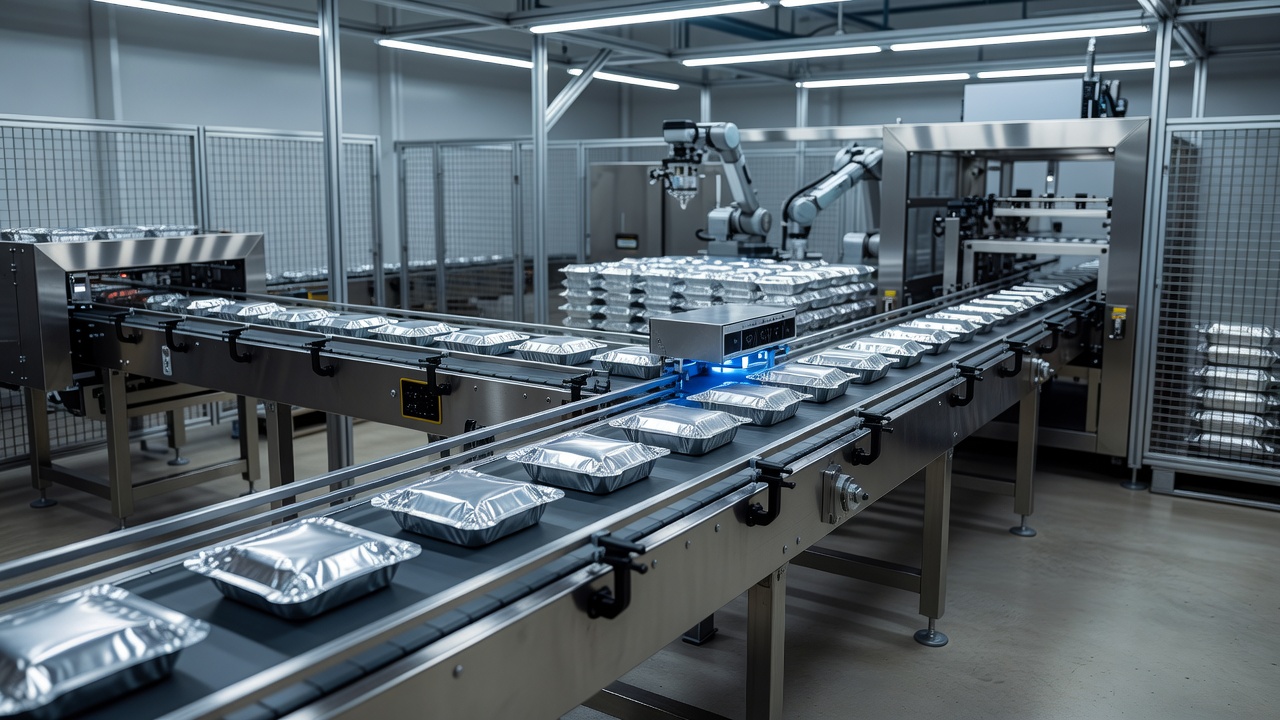
Give every result a physical destination
The inspected portion leaves the camera before the model has finished processing. Downstream, another item may already occupy the reject position. The integration design must preserve the relationship between a captured image, its result and the physical item throughout that movement.
Define where item identity begins and ends. A trigger sequence, encoder position or carrier identity may support tracking, depending on the machine. Test gaps, double feeds, stopped belts and restarts. If products can slide, rotate or change lanes, explain how the system detects or bounds that uncertainty rather than assuming a perfect conveyor.
Specify the complete timing budget
Measure acquisition, transfer, processing, communication and actuator response together. Average model inference time is not a sufficient deadline. The longest credible delay, variation under load and controller scan behaviour may determine whether an item can still be acted upon.
For illustration, a product travelling 0.5 metres at a constant 1 metre per second reaches the downstream point in 0.5 seconds. That is not all available computation time: the actuator needs its own lead time and engineering margin. Variable speed and belt stops usually require position-aware tracking rather than a fixed delay copied from a demonstration.
Define result states explicitly. Acceptable, defective, uncertain, uninspectable, late result and missing result are different situations. The controller should not interpret a disconnected inspection computer as a stream of good products. Agree the response for each state through the site's risk assessment and operating procedures.
The result must arrive on time, refer to the right item and cause the authorised response.
Confirm the action, not just the command
A reject command does not prove that a product entered the reject container. Pneumatic pressure can fall, a diverter can jam and a bin can become full. Where the operating requirement calls for confirmed removal, use a validated confirmation arrangement and define the response when confirmation is missing.
Include handling after rejection. Segregated material should retain enough identity for authorised review and disposition. Prevent an informal re-feed from bypassing the inspection rules. When an operator overrides a decision, record the reason, the user role and the affected product or production interval in proportion to the site's requirements.
Machine safety remains a separate engineering discipline. ISO 12100 provides a machinery risk-assessment framework. ISO 13849-1 and IEC 62061 address safety-related control systems within their respective scopes. A quality inspection model is not automatically a safety-rated component, and a production-quality stop must not be confused with a validated protective function.
Make the interface contract explicit
Document the data exchanged between the inspection computer and the programmable logic controller: item identifier, result, reason code, timestamp or position reference, recipe version and system health. Define acknowledgements, timeouts, sequence checks and recovery after a network interruption.
The OPC Foundation maintains OPC UA, which can support structured industrial information exchange. PROFIBUS & PROFINET International supports PROFINET technology. Selecting a recognised protocol does not by itself establish delivery deadlines or correct fault behaviour; the application contract and its tests still matter.
For wider integration, ISA-95 and IEC 62264 describe enterprise and control-system integration models. IEC 62443 addresses industrial automation and control-system cybersecurity. Use these frameworks where relevant to define access boundaries, controlled changes and network responsibilities, rather than adding unrestricted remote access to the inspection station.
Give operators information they can use
Show a clear reason for the line's state. Operators need to distinguish rising cosmetic defects from a dirty camera window or a failed reject sensor. Present recent examples, system health and the active product specification without making a confidence score look like a probability of food safety.
Track inspection counts and physical product counts with defined denominators. Record start-up checks, changeovers, interventions and lost inspection intervals. At batch review, an apparent improvement in reject rate should be investigated if it coincides with missing images or an unapproved threshold change.
Finally, challenge the integrated system during factory and site acceptance testing. Include realistic speed changes, power recovery, communication loss and unsuccessful rejection. The evidence should demonstrate the complete checkpoint, not only that one saved image received the intended label.